Deterministic workflow or AI agent: why Riplics uses both
A workflow repeats the same steps; an AI agent adapts but costs more and varies. How Riplics combines the two, with our own figures.
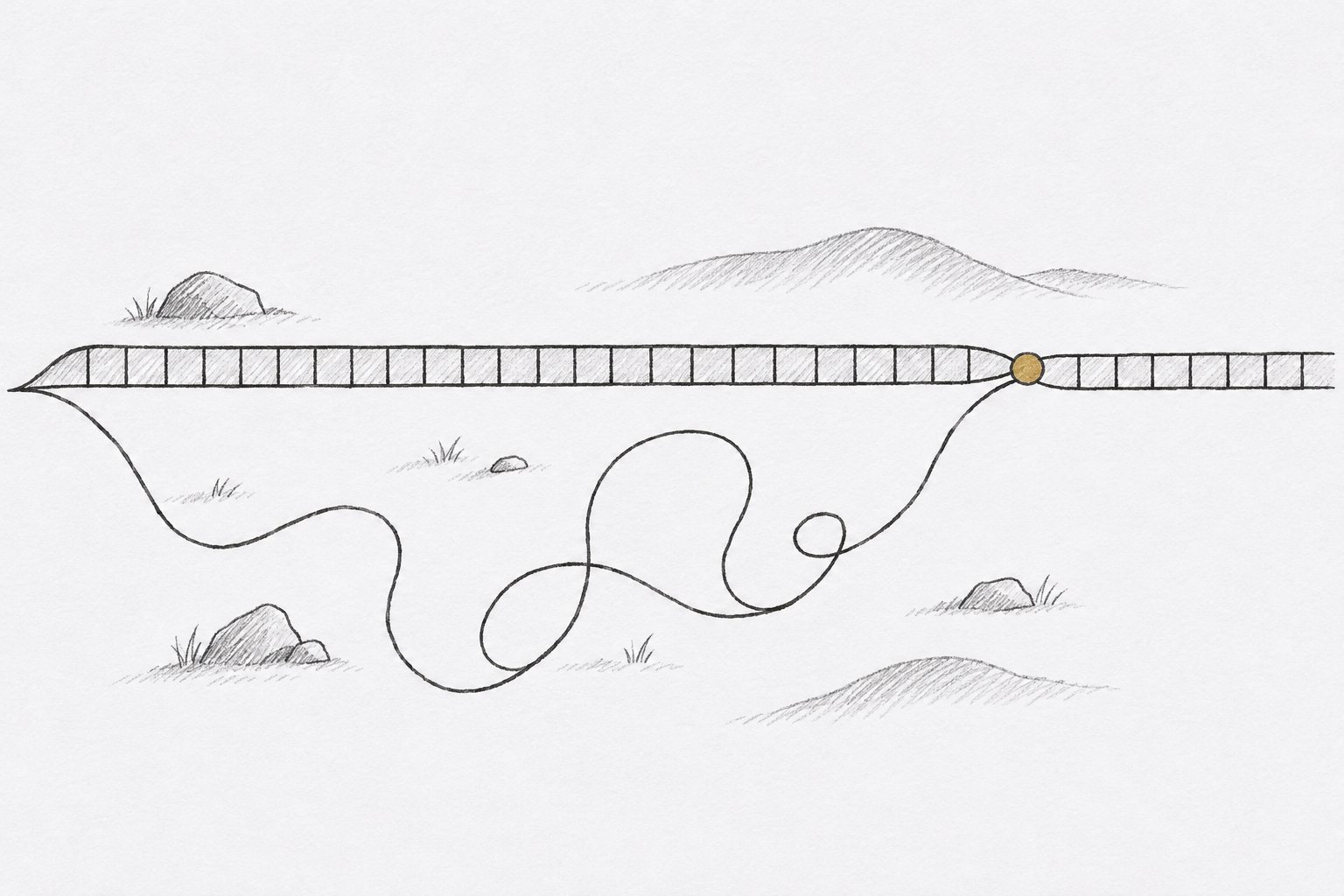
There are two ways to automate a recurring task. The first is a deterministic workflow, like a Make, Zapier or n8n scenario: a fixed sequence of steps, written once and replayed exactly. The second is an AI agent: you give it a goal, and it decides the steps for itself on each run.
They are often presented as two opposing camps. We used both for the same tasks at a real small business, and we kept neither on its own.
What a deterministic workflow does well
It does the same thing every time. With the same input data, you get the same result, and you can read each step to understand where it came from. A run costs almost nothing because no AI model is called.
Anyone who maintains one knows its limits. The day a website moves a button, the step breaks and everything stops. It cannot write. And someone who knows the tool has to build it, then repair it.
What an AI agent does well
It understands a request written in one sentence, finds its way around a page it has never seen, and writes. That makes it useful to someone who has never opened an automation tool.
We measured its limits while building Riplics.
- Cost
- When our agent browsed three competitor websites to collect their news, it spent $1.75. The same collection task, rewritten as code, has since cost between 1 and 5 cents per run.
- Variation
- We asked the same model twice to design a comparison table for the same business. It kept the same themes but renamed the columns. Two tables you can no longer compare from one week to the next are no use.
- Invention
- Our first price monitor let the AI compare two catalogues itself. It reported a €400 increase by comparing two different products.
None of these flaws shows up in a single trial. They appear when the same task runs every week.
What Riplics does: the agent builds, the code replays
The first time, an agent does the task. You describe it in the chat or show it in the browser. What it did is recorded as a sequence of steps you can review and change in a visual editor.
On later runs, those steps are replayed. Reading pages, keeping new entries, comparing and filling a table are all code, without a model. A model is called only for writing steps, using facts already established.
Once: the agent builds
- You describe the task or show it in the browseryou
- The agent does it for the first timeagent
- Its steps are saved: you can review and change themsaved
Every week: the code replays
- Read the pagescodeA step breaks? The agent repairs that step, within its budget. agent
- Keep new entries and comparecode
- Fill the tablecode
- Write the summary from these factsmodel
- Wait for your approval before sending or publishingyou
- An AI model is working
- No model
What needs deciding once is decided once. The comparison table we mentioned is now chosen during setup and saved as a step you can change. Each run simply fills it in.
When a step breaks, the agent returns
This is where a traditional workflow stops and waits for a person. In Riplics, if a website has changed and a step can no longer find its button or table, the agent is called back to repair that step alone. Completed steps and their results stay in place.
This repair has a budget for each run.
- 90 sof repair time
- 8operations
- 3model calls
- $0.25at most
A fix is kept only if the step then succeeds and the collected rows pass the quality checks.
One thing is never retried automatically: a write action. If a click that sends or publishes something has gone through but its result is uncertain, there is no second click.
We would rather stop a run than send an email twice.
The approval rule follows the same principle. It is enforced by the server rather than the model: anything that publishes, sends or pays waits for your approval, whatever the agent has read or decided.
The three approaches side by side
| Deterministic workflow | AI agent alone | Hybrid (Riplics) | |
|---|---|---|---|
| Setup | Built by hand, step by step | One sentence | One sentence or a demonstration, then steps you can review |
| Same result from one run to the next | Yes | Not guaranteed | Yes for collection and calculations; writing varies |
| A website changes | The step breaks | It adapts | The step is repaired within a fixed budget |
| Cost per run | Almost nothing | The cost of an agent, every time | A few cents; a model only writes at the end |
| Writing | No | Yes | Yes, using facts checked by code |
| What you can review | Every step | The conversation | Every step and every run's log |
What the hybrid approach does not solve
The initial build costs as much as using an agent. Our price monitor cost $0.56 to build, then 3 to 4 cents per run. For a task you will do only once, recording steps has little value, and it is better to ask the agent directly.
A repair can fail. The run then stops and tells you why, as a traditional workflow would. And a website that blocks bots blocks them all, whatever the method.
Writing is still a model's work, with its flaws. It arrives as a draft, and you need to review it.
How to choose
If the task is identical every week and uses tools with stable APIs, a traditional workflow is enough, and you do not need us.
If it is a question you will ask only once, an agent is enough.
The hybrid approach is useful between the two: a recurring task that reads websites likely to change, ends with a piece of writing, and needs your approval of the result. That describes most marketing tasks in a small team, and those are the tasks Riplics is built for.